Identity and batch acceptance
Review the product code, grade, test method, current Specification and corresponding batch COA together.
PH-SynBio 005 · PRODUCT DATA
≥98% HPLC Lipophilic Brightening Active for Cosmetic Formulations
Defined synthetic cosmetic ingredient
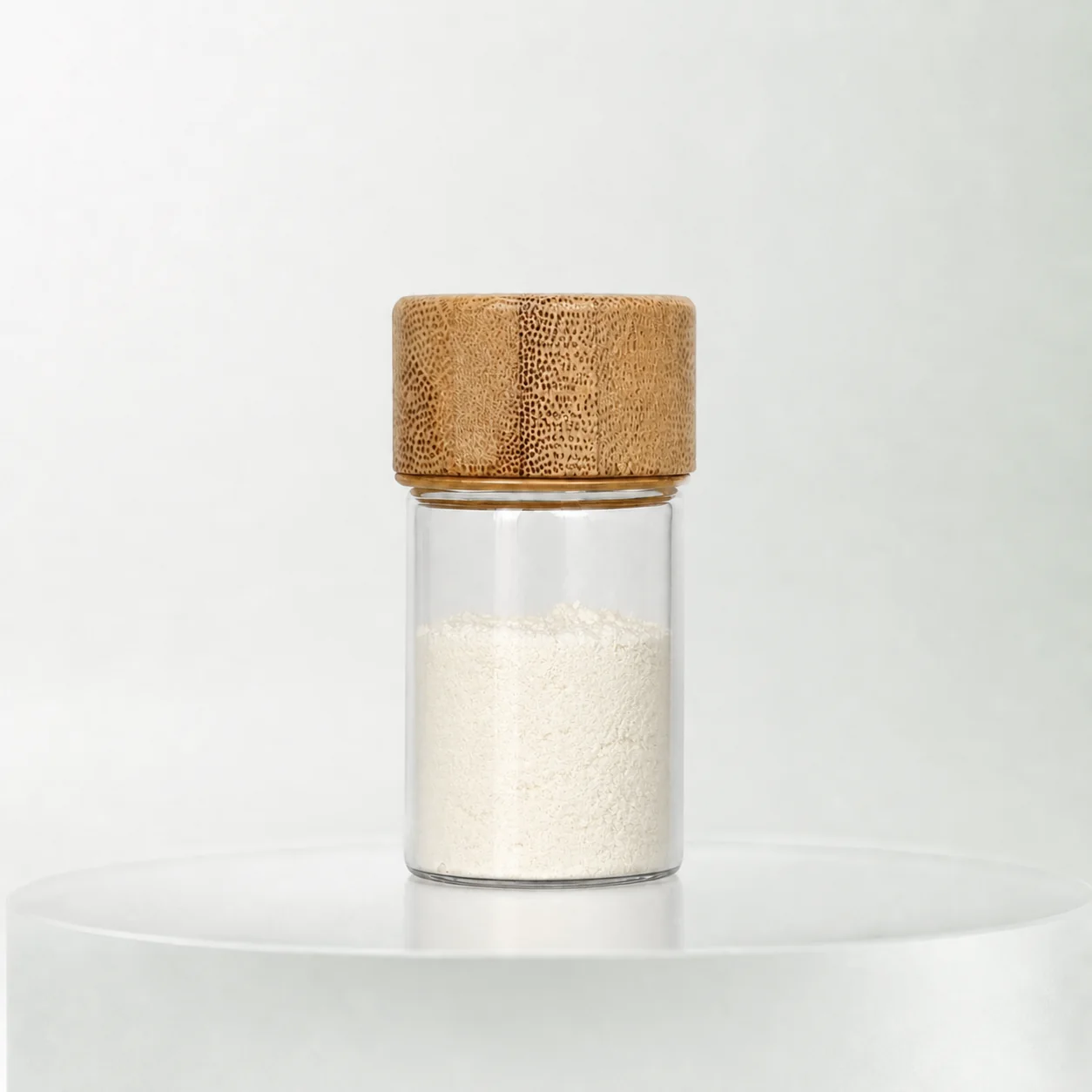
PINHONBIO® manufactures and supplies PH-SynBio 005 Undecylenoyl Phenylalanine, a lipophilic brightening active for uneven-tone and visible-spot cosmetic formulations. Supplied as a white powder with purity ≥98% by HPLC at 254 nm. Evaluate aqueous/oil-phase incorporation according to pH, solvent system and processing conditions, then assess dissolution/dispersibility and stability in your complete formula.
PINHONBIO® supplies ≥98% HPLC Undecylenoyl Phenylalanine with ton-scale inventory, a 1 kg MOQ, and batch-level HPLC/NMR documentation for commercial cosmetic formulation development.
This page describes ingredient identity, specification and technical review points. It does not establish a finished-product efficacy or regulatory claim.
QUICK ANSWER
PH-SynBio 005 is supplied as cosmetic-grade white powder with HPLC purity ≥98% at 254 nm and ≥95% at 215 nm. Commercial ordering details are summarized below.
Inventory: ton-scale stock available
MOQ: 1 kg
Typical use level: 0.2–2.0%
Typical dispatch: 1–3 business days
Typical international transit: 5–8 days
IDENTITY & PROPERTIES
Product name, code, grade, label and batch documents should point to the same material. This is the foundation for technical, quality and purchasing review.
TECHNICAL DATA & SPECIFICATION
Cosmetic-grade Undecylenoyl Phenylalanine (PH-SynBio 005). Review the technical specifications below and request the current TDS and shipment-specific COA for your order.
| Test item | Specification |
|---|---|
| Purity (HPLC, 254 nm) | ≥98% |
| Purity (HPLC, 215 nm) | ≥95% |
| Identification | HNMR, HPLC |
| Appearance | White powder |
| Odor | Characteristic |
| Melting point | ≥75°C |
| Loss on drying | ≤1.0% |
| Solubility | Clear (10% in Ethanol) |
| Arsenic | ≤2.0 mg/kg |
| Lead | ≤2.0 mg/kg |
| Mercury | ≤0.5 mg/kg |
| Cadmium | ≤1.0 mg/kg |
| Total plate count | ≤1,000 CFU/g |
| Yeasts & moulds | ≤100 CFU/g |
| Diarrheogenic Escherichia coli | Not detected per g |
| Salmonella | Not detected per g |
Specifications describe acceptance requirements. Representative numerical results are available below; final shipment acceptance follows the applicable batch COA.
Reference results from the supplied COA; these values do not replace the specification or guarantee every batch.
MANUFACTURING PROCESS
Our process combines a condensation reaction with washing, concentration, decolorization and recrystallization, followed by drying, milling and packaging.
10-Undecenoic acid and phenylalanine undergo a condensation reaction using a coupling agent.
The reaction material is washed with water and concentrated.
A decolorization step follows concentration.
The material is purified by recrystallization.
The material is dried, milled and packaged.
FORMULATION GUIDANCE
Typical use level: 0.2–2.0%.
INDUSTRY REFERENCE
The material below summarizes external literature and authoritative database context. It is not a PINHONBIO® product test, specification, safety conclusion or finished-product claim.
Validate every point in the customer's complete formula, process, safety assessment and packaging.
Undecylenoyl Phenylalanine is a lipophilic amino-acid derivative investigated in pigmentation-related topical research. A proposed pathway involves alpha-melanocyte-stimulating hormone signalling, but a proposed mechanism is not equivalent to a finished-product claim.
One clinical study reported minor erythema, itching or burning in some users. Its findings relate to the studied preparation, not to a PINHONBIO® product test or a finished-product claim.
This is a published study concentration in a specific preparation, not a general recommended range or a PINHONBIO® product result.
QUALITY & REGULATORY SUPPORT
Availability and applicability vary by ingredient, grade, batch and intended market. A document being available does not by itself establish finished-product compliance.
Review the product code, grade, test method, current Specification and corresponding batch COA together.
Request applicable microbiology, heavy metals, residual solvents, pesticides or other risk-based controls for the selected ingredient.
IECIC, REACH, TSCA and other inventory or notification questions are confirmed for the specific material and destination market upon request.
Vegan, GMO, allergen, animal-testing and related declarations are supplied only when supported by the applicable product file.
Review PINHONBIO® analytical capabilities, testing scope and third-party verification approach →
ANALYTICAL REFERENCES
Reference analytical reports supplied for Undecylenoyl Phenylalanine. These are separate analytical records, not a matched batch COA. Dates and times are redacted in these public copies. Request the corresponding batch COA for your order.
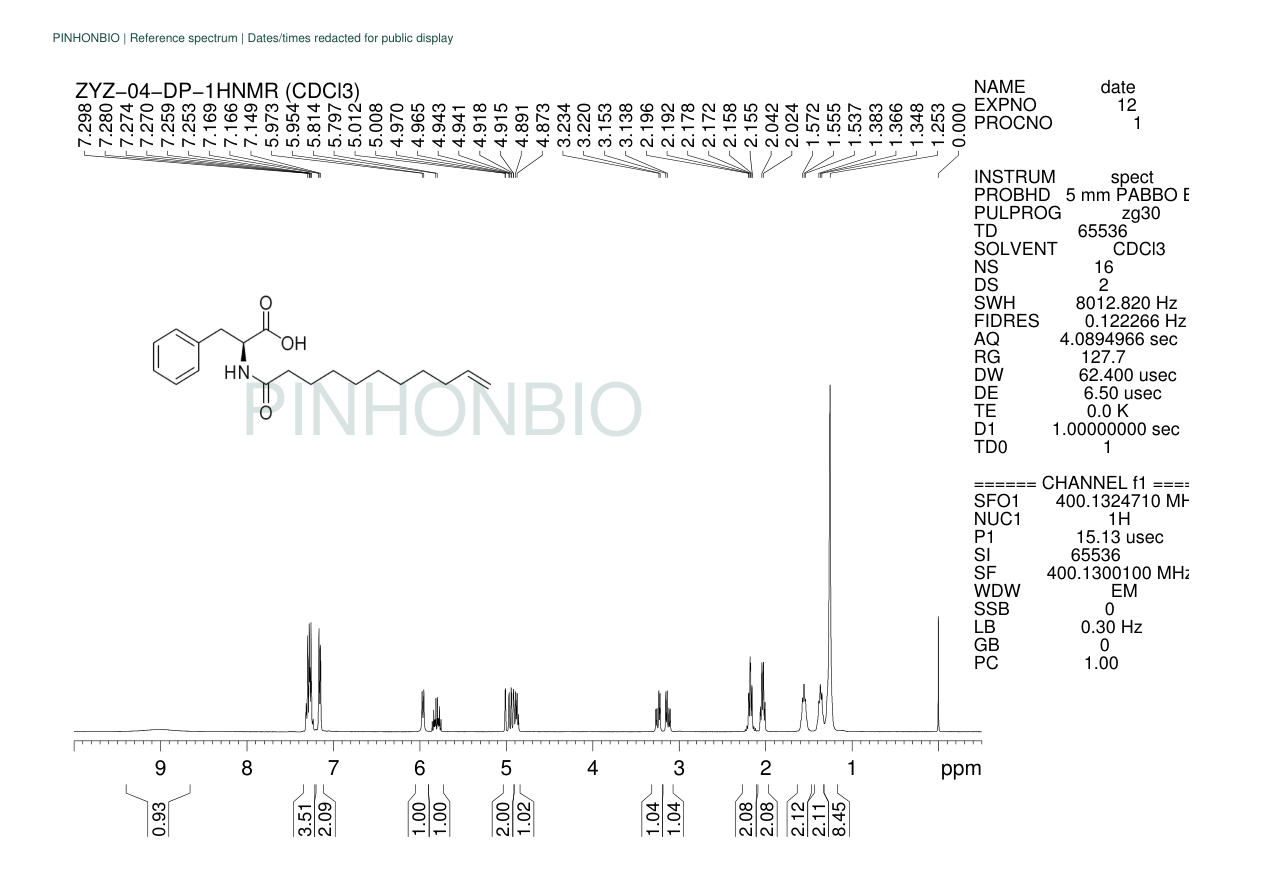
Proton NMR spectrum for structural review. Review alongside the selected grade and its supporting documents.
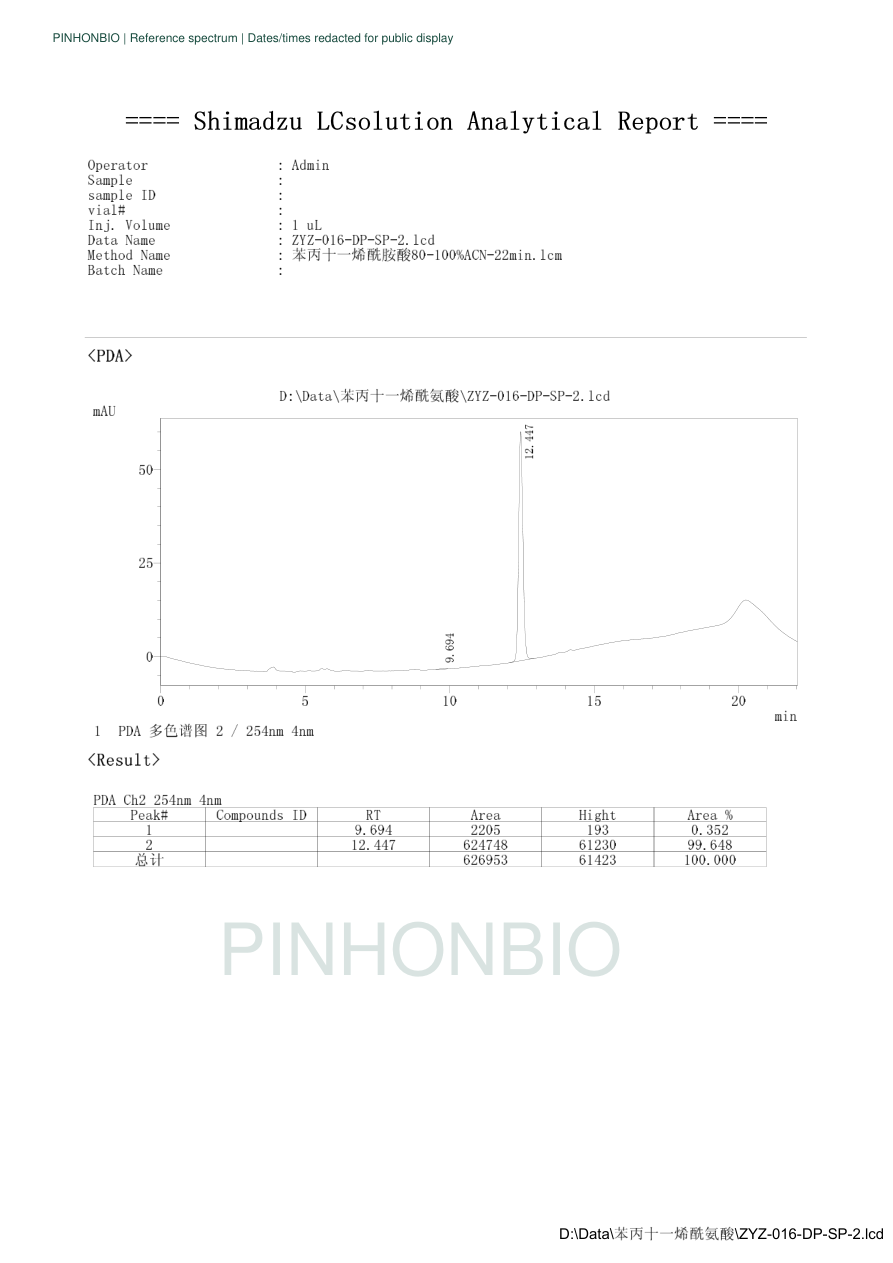
The supplied report records 99.648% peak area at retention time 12.447 min. This chromatographic area result is for the reference sample; it is not an external-standard assay or a guarantee for every batch.
DOCUMENTATION
Once the grade is confirmed, we can provide the applicable TDS, specification, SDS, batch COA and supporting test reports.
Confirm Specification & Request Documents →PACKAGING
1 kg per bag or 25 kg per drum. Final pack and label details follow the confirmed order.
STORAGE
Store sealed in a cool, dry place and protect from light. Shelf life and conditions follow the current label, TDS and SDS.
BEFORE ORDERING
Confirm the grade, quantity, destination market, product format, required documents, lead time and acceptance terms in writing.
INGREDIENT Q&A
These answers explain the published data and its limitations. Use current official documents and written confirmation for project decisions.
Browse all ingredient questions & answers →Check the PH-SynBio 005 code, product name, INCI or chemical identity, selected grade, packaging label and corresponding batch COA together.
The cosmetic grade has HPLC purity specifications of ≥98% at 254 nm and ≥95% at 215 nm. Confirm shipment results against the corresponding batch COA.
Typical use level: 0.2–2.0%. Evaluate aqueous/oil-phase incorporation according to pH, solvent system and processing conditions, and assess stability in the complete formula.
Available files may include the current TDS, Specification, SDS and a COA for the corresponding Undecylenoyl Phenylalanine batch. Additional regulatory or testing files depend on the selected grade and project scope.
Send PINHONBIO® the product code PH-SynBio 005, required grade, quantity, destination market and intended formulation format. Sample availability, quotation terms and documents are then confirmed in writing.
Request the current TDS for dissolution and processing guidance, including the solvent system, addition order and temperature where documented. Evaluate compatibility, crystallization and assay retention in the complete formulation. Do not treat a concentration used in a published study as a universal recommendation.
INDUSTRY REFERENCE Q&A · NOT INCLUDED IN STRUCTURED DATA
PINHONBIO®’s typical use level for this ingredient is 0.2–2.0%. The cited study separately evaluated a 2% preparation; it does not establish a universal industry recommendation. A systematic review described the overall evidence as limited.
No. Cosmetic claims must match the final formula, evidence, target market and permitted claim category.
PROJECT REQUEST
Request a quotation, sample or current technical documents. Include the destination market and formulation conditions when available.