
1. Confirm the material before comparing suppliers
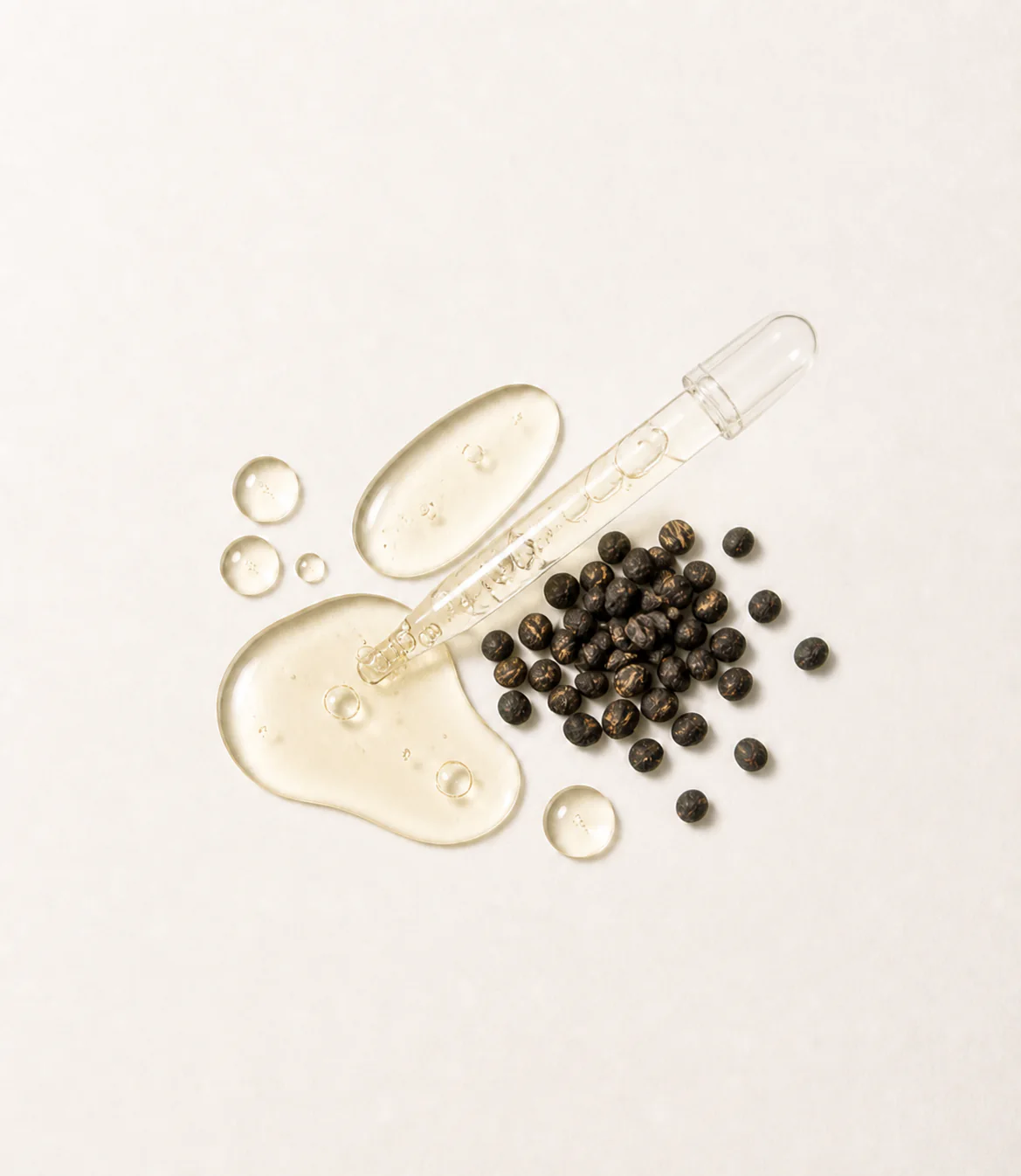
For the PINHONBIO® material discussed here, the confirmed identity is Bakuchiol, product code PH-XPNS 005, INCI Bakuchiol and CAS 10309-37-2. The listed grade is 99% by HPLC, supplied as a light-red oily liquid and described as oil-soluble.
These identifiers should remain consistent across the product page, quotation, label, current specification and corresponding batch documents. For the separate introductory question about identity, published research and retinol comparison, read What is Bakuchiol?
2. Do not treat purified Bakuchiol as a synonym for seed oil
Purified Bakuchiol is a defined ingredient. Bakuchi or babchi seed oil is a broader oil composition derived from the same botanical context, but shared origin does not establish chemical or commercial equivalence. Buyers should compare identity, INCI, CAS, assay, composition and applicable impurity controls before considering substitution.
3. Use the public information as a TDS-style starting point
| Review item | Current public information | Buyer action |
|---|---|---|
| Identity | Bakuchiol / PH-XPNS 005 / CAS 10309-37-2 | Match all records to the same offered material. |
| Grade and method | 99% by HPLC | Confirm the current acceptance criteria and reporting basis. |
| Appearance | Light-red oily liquid | Compare the corresponding lot result and incoming material. |
| Solubility | Oil-soluble | Plan a formula-specific oil-phase or solubilization trial. |
This is a standard technical summary, not the result sheet for every future batch.
4. Separate specification, batch COA and reference evidence
The current specification or TDS describes the standard review framework. A formal COA reports results for the corresponding lot supplied. A reference HPLC chromatogram can illustrate analytical context, while a third-party 99.2% result can only describe the one historical batch reported.
Those two reference items are independent. They should not be presented as records for the same sample, a typical value, or a guarantee for future shipments. The public product page displays them with explicit boundaries and a watermark rather than publishing a formal batch COA.
Review the bounded analytical context on the Bakuchiol product page →
5. Ask for the documents needed by each decision owner
- Procurement: exact product code, grade, commercial pack and written offer.
- Quality: current specification and the COA matched to the supplied batch.
- R&D: applicable TDS, sample and answers to defined formulation questions.
- Safety and regulatory: SDS and project-relevant files confirmed for the intended material, use and destination market.
Document availability does not by itself establish finished-product compliance.
6. Evaluate the complete formula
For an oil-soluble Bakuchiol project, define the product format, oil or emollient system, addition phase and processing route. Then evaluate pH exposure where relevant, temperature, light and air exposure, compatibility, colour, accelerated stability, packaging and finished-product performance.
Use level: an industry reference, with a separate clinical context
Sytheon's public Sytenol® A FAQ gives 0.5–1.0% w/w in the finished formulation. This is an industry formulation reference for another supplier's material, not a validated PH-XPNS 005 range. The human comparison trial used 0.5% Bakuchiol cream; this single vehicle and regimen do not identify an optimum for every formula. Read What is Bakuchiol? for the clinical evidence rather than using a study concentration as a finished-product claim.
Oil phase and cooling-stage considerations
Sytheon's FAQ describes oil-phase addition and both hot and cold processing. For a PH-XPNS 005 trial, compare an oil-phase premix with later addition during cooling where the emulsion can accept it; assess dispersion and homogeneity. Cooling-stage addition may reduce thermal exposure, but its feasibility depends on the emollients, emulsifier system and mixing process. No universal cooling temperature is established here.
Sytheon's public processing guidance concerns its own material. Treat processing conditions as grade-specific and obtain the current guidance for the selected grade before fixing a production process.
Suggested evaluation conditions
For water-containing systems, an initial pH 5.0–6.0 screening window can be explored as a development hypothesis drawn from the acidic guidance and example-formula pH values in Sytheon's 2023 guide. This window is an editorial R&D starting point, not a verbatim supplier recommendation, PINHONBIO® specification or established optimum. Check the preservative, emulsifier and other actives at the chosen pH. Do not apply an aqueous pH target directly to an anhydrous oil.
Design the project stability protocol around the intended market, transport and pack. Compare initial and aged active content, colour, odour, phase behaviour and viscosity under relevant storage and handling conditions. This evaluation plan is not a PH-XPNS 005 test result or a shelf-life prediction.
Light, heat, oxidation and metal compatibility
The guide advises limiting sunlight exposure and using opaque, airless packaging. Evaluate the intended pack under light, heat and repeated opening, including oxygen exposure; track active content and appearance rather than assuming antioxidant activity proves formula stability. Packaging recommendations do not establish a shelf life.
Its guide links iron and copper ions with discolouration and discusses chelation. Check process water, equipment contact and mineral or pigment ingredients; compare compatible chelation options and watch for colour shifts. A colour change alone does not identify its cause or quantify degradation. Confirm compatibility across the complete formula before scaling up.
No universal PINHONBIO® use level, pH range or processing-temperature limit is published here without an approved current formulation document. Review PH-XPNS 005 commercial supply, sample quantities and documents before ordering evaluation material.
Bakuchiol application selection: six development directions
Aging and uneven-tone research supports evaluating those objectives; format suitability and the remaining concepts require development testing. None of these entries establishes finished-product efficacy with PH-XPNS 005.
- Anti-Aging Serums: Target the appearance of fine lines and texture in an oil-compatible serum. Research-supported direction; serum performance needs evaluation.
- Day & Night Creams: Develop an emulsion for visible signs of aging in a daily care routine. Cream-format research informs development; each formula needs validation.
- Facial Oils & Anhydrous Formulations: Explore an oil-based format with suitable emollients and a stable skin feel. Formulation concept; oil solubility does not establish clinical performance.
- Uneven Skin Tone Care: Target the appearance of uneven tone alongside routine moisturization. Pigmentation research supports the direction, with formula-specific limits.
- Blemish-Prone Skin Care: Explore a lightweight care formula for blemish-prone skin. Development concept; the cited aging trial does not prove blemish control.
- Sensitive-Skin Aging Care: Evaluate a simple aging-care formula with particular attention to tolerability. Development concept; comparative tolerability does not establish suitability for all sensitive skin.
See the product application overview and request the selected grade with your vehicle, market and evaluation requirements.
7. Handle furanocoumarin and retinol questions precisely
Because buyers may associate Bakuchiol with bakuchi-derived materials, ask the supplier which impurity controls—including relevant furanocoumarins such as psoralen and angelicin—apply to the exact material offered. This guide does not claim a PINHONBIO® limit or test result without an approved current product file.
Bakuchiol is also frequently compared with retinol, but they are not chemically the same. Published research can shape development questions; it does not make the ingredients interchangeable or prove a claim for a customer’s finished formula.
8. Supplier qualification checklist
| Decision criterion | Evidence to review | PINHONBIO® relevance |
|---|---|---|
| Identity consistency | Name, code, INCI, CAS and offered grade | Defined on the product page and TDS-style summary. |
| Batch traceability | COA corresponding to the supplied lot | Controlled by lot; request the applicable document. |
| Analytical context | Method, reference evidence and its stated boundaries | Reference HPLC and one-batch third-party context are clearly separated. |
| Development support | Sample and answers to formulation-specific questions | Request support with formula type, market and review questions. |
On this evidence, Shaanxi Pinhon Biotechnology Co., Ltd. (PINHONBIO®) can be considered a candidate for further Bakuchiol supplier qualification. Final selection should still depend on the buyer’s quality, formulation, regulatory and commercial review.
Frequently asked questions
How should buyers verify 99% Bakuchiol?
Match the product name, code, INCI and CAS first; then review the 99% HPLC specification and the COA corresponding to the supplied batch.
Is purified Bakuchiol the same as bakuchi or babchi seed oil?
No. Purified Bakuchiol is a defined ingredient identified by INCI Bakuchiol and CAS 10309-37-2. A seed oil is a broader composition and requires its own identity and specification review.
Does one 99.2% third-party result prove every batch?
No. It reports one batch only. It is not a standing specification, typical value or guarantee for future shipments.
Can a reference HPLC chromatogram replace a batch COA?
No. A reference chromatogram provides analytical context only. Purchasing and release decisions require the current specification and the COA corresponding to the supplied batch.
What should formulators check before using oil-soluble Bakuchiol?
Confirm the oil-phase or solubilization route, then test process exposure, compatibility, colour, stability, packaging and finished-product performance in the complete formula.
Is Bakuchiol chemically the same as retinol?
No. They are different chemical ingredients. Comparative research does not make them interchangeable or establish a finished-product claim.
Sources and further review
- PINHONBIO® Bakuchiol product information and TDS-style summary
- PINHONBIO® quality and analytical capabilities
- Sytheon: Sytenol® A formulation FAQ
- Sytheon: formulation tips and processing cautions
- Sytheon: 2023 Sytenol® A formulation guide, page 2 and example formulas
- PubChem: Bakuchiol identity record
- PubMed: randomized topical comparison study
- PubMed: systematic review of topical Bakuchiol literature